
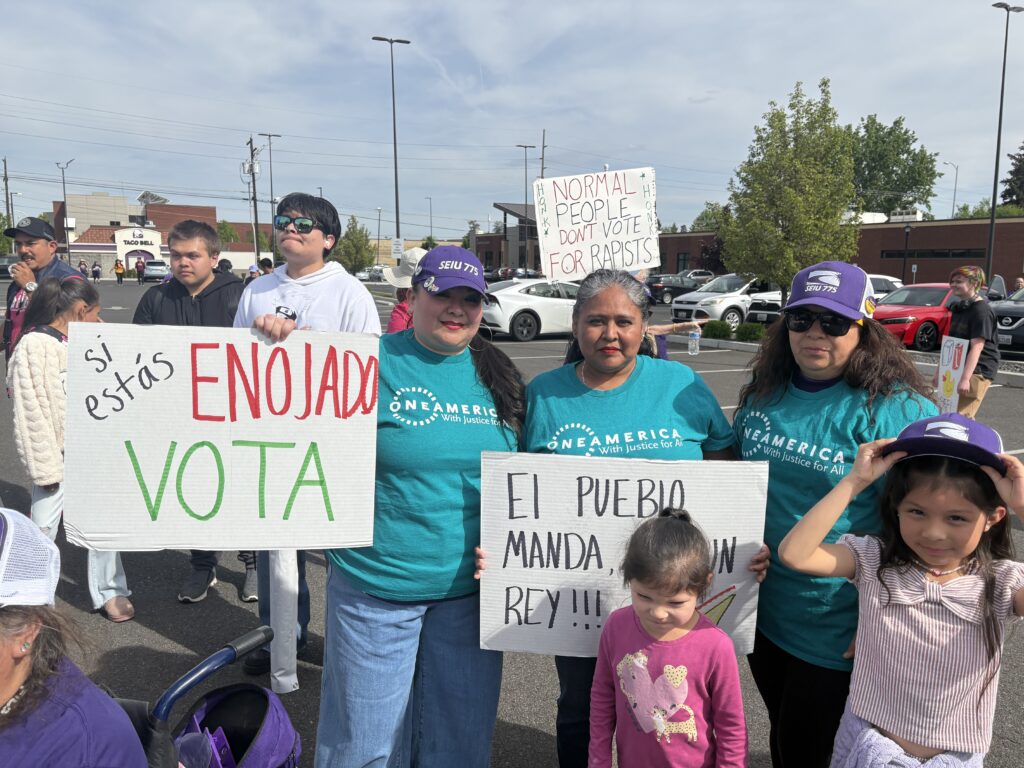
Happy (belated) May Day!
May 1 was International Worker’s Day, also known as May Day. Thousands of people came out in Seattle to show their support for workers and hundreds more showed up in cities like Yakima, Vancouver, and Sunnyside.
We joined a nationwide call for no work, no school, and no shopping on May Day. There were nearly 3,500 May Day marches and rallies this year. One organization estimated 100,000 students would call out of school for May Day.
This year, we were fighting to demand that our country put workers over billionaires and wealthy corporations. Right now, families are being forced to choose between paying for rent or buying groceries because of rising prices. We’re being told to blame and fear our neighbors because of where they come from or what language they speak at home. Meanwhile the wealthiest Americans only get richer.
That’s exactly why May Day is important: it reminds us of what is possible when we come together. It encourages us to dream of a world where we all have enough. And it shows the power of our solidarity.

Before we get to the news, first a little May Day history:
May Day & Immigration
As a workers’ holiday, May Day came from the movement for an eight-hour workday in the 1880s. Tens of thousands of workers in cities across North America went on strike to win “eight hours for work, eight hours for rest, eight hours for what we will.”
That epicenter of that movement was Chicago. In May 1886, during a big labor protest in Haymarket Square, a bomb exploded, killing both demonstrators and police officers. In response, police fired into the crowd, causing even more deaths. Eight men were arrested in the aftermath and charged with the attack. But there was no hard evidence linking them to the bombing; only two of them were at protest in the first place. Seven of the eight were sentenced to death and the remaining man was sentenced to fifteen years in prison.
Even at the time, their trial was criticized for being unfair, and across the world, people protested for their freedom. However, that didn’t stop the US government, which used the bombing as an excuse to crack down on labor organizing, arresting hundreds of union members and sympathizers across the country – and setting back the cause of the eight-hour workday.
May Day today commemorates the struggle for their freedom – as well as celebrating workers’ victories that have come since. The fight for workers rights was just beginning in the 1880s – and workers did eventually win an eight-hour workday.
A Day Without Immigrants
Since the beginning, May Day and the US labor movement have always been closely tied to immigration. This is due to both policy and logistics: US immigration policy has been shaped because of the need for labor, and new Americans always need to find ways to support their families.
Immigrants have been at the heart of the labor movement in America right from the beginning. From Jewish garment workers organizing in factories in New York to Mexican and Filipino farmworkers leading boycotts in California, the history of the labor movement is a history of immigration. Indeed, six of the eight defendants in the Haymarket trial were themselves immigrants to the US, coming from Germany and the UK.
Unions and immigrant rights organizers – including OneAmerica – have mobilized on May Day to make the link between workers rights and immigrant rights clear. On May 1, 2006, millions of people across the country marched in the streets to support a comprehensive path to citizenship for immigrants and fight proposed changes to U.S. immigration policy that would have criminalized immigration. That May Day was dubbed “A Day Without an Immigrant.” 15,000 people marched in Seattle. 12,000 marched in Yakima.
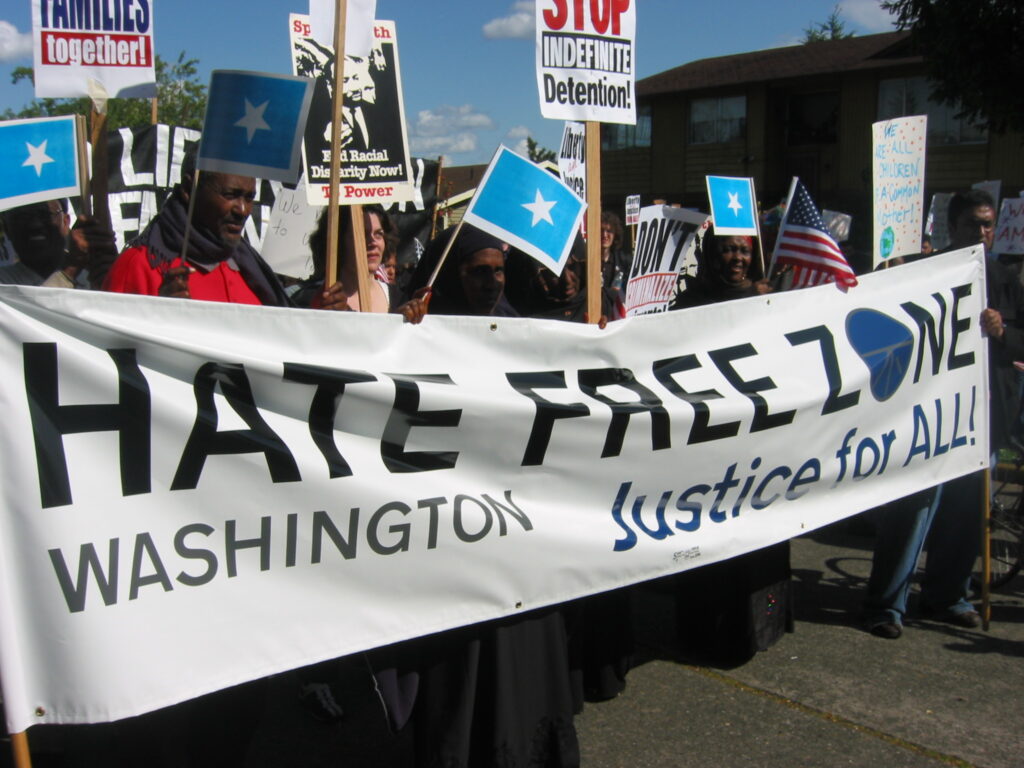
Billionaires and wealthy corporations try to pit us against each other. By linking our struggles together we stand in solidarity and show our power. The fight for immigrant rights is the fight for worker rights.
And the only way to win is to make sure all workers earn enough to support their families and have the protection they need at work to thrive.
DHS Funding Shenanigans
Last week, the longest government shutdown in history (76 days!) ended. The House of Representatives finally passed the Senate’s bill funding the Department of Homeland Security – except for ICE and CBP.
The passage of this funding bill sets up the next battle over money for ICE and border patrol, which will happen this summer. Now, Republicans in Congress have proposed a budget resolution that includes $72 billion in new mandatory funds for ICE and CBP, without guardrails or accountability.
ICE and CBP are already swimming in money. Thanks to the $170 billion provided for immigration enforcement in last summer’s One Big Beautiful Bill, these agencies have more money than ever. That bill cut funding for our health care and food aid to fuel deeply unpopular and violent immigration enforcement.
The president has set a June 1 deadline for this bill, which Republicans plan on moving through the reconciliation process. This means that they won’t need any Democratic votes; reconciliation lets the party in control of the Senate pass mandatory spending bills with a 51-vote simple majority. But it also means that all Republicans need to stay united to pass the bill.
Republicans are forcing this funding through reconciliation because they know ICE is deeply unpopular. Across the country, people are fighting back against this out-of-control agency. Americans want our government to invest in our communities, not deportations.
Voting Rights
Last Wednesday, the U.S. Supreme Court ruled on Louisiana v. Callais. The conservative majority voted to significantly weaken and dismantle Section 2 of the Voting Rights Act. Section 2 protected the voting power of people of color and promoted fair representation, preventing districts which dilute the voting power of communities of color. Now, the Supreme Court has reinterpreted these protections, making it essentially impossible to enforce this law.
This is just the latest ruling to gut our voting protections and weaken our democracy.
Because of this decision, the door is open for states to redraw Congressional and legislative maps, gerrymandering districts to prevent voters of color from being able to select their preferred candidates. This Supreme Court decision basically provides a roadmap for how states can return to drawing discriminatory electoral districts and weaken the voting power of communities of color. Bluntly, this ruling will likely reduce the number of people of color in elected office, especially in the South. Before the ruling, NPR estimated that at least 15 House districts represented by Black members of Congress could be at risk without Section 2.
As we head into midterm elections, where Democrats are currently polling much better than Republicans, this is especially important heading into the midterm elections and take away the choice of millions of people to elect the candidates of their choice.
This is bad news, but it also isn’t surprising; conservatives have been organizing for decades to dismantle the Voting Rights Act. But here in Washington, we’ve been organizing too.
However, one important note on this ruling: it only applies to federal voting rights act. State voting rights laws, like the Washington Voting Rights Act (WVRA), remain untouched. This is why we worked hard this last legislative session to strengthen the WVRA, passing preclearance (HB 1710) – which the Supreme Court weakened in the 2013 Shelby v. Holder case) and guidance on voter suppression and vote dilution (H 1750) – which is part of what the Supreme Court attacked in the Callais case.
Our country is founded on the principle of democracy: that our government belongs to us. When that erodes, it endangers every value, every protection, every community. And we have to protect it.
TPS Update
Temporary Protected Status, or TPS, is U.S. immigration designation for foreign nationals from countries experiencing ongoing armed conflict, environmental disasters, or extraordinary, temporary conditions. It provides work authorization and protection from deportation, but it does not lead to lawful permanent residence. There are currently about 1.3 million people living in the US under TPS. Every president since the program was established in 1990, with the exception of Donald Trump, has supported TPS.
The decision to grant TPS to a certain nationality is completely up to the Secretary of DHS, and it is generally not up for judicial review. The Trump Administration has been trying to end TPS, canceling it for people who have lived in the US for two or three decades.
Advocates are fighting in the courts to keep it. There are several pending lawsuits, and last week, the Supreme Court heard two cases involving 350,000 Haitians and 6,000 Syrians who the President is trying to expel from the US. The ruling will likely impact everyone under TPS protections.
TPS is emblematic of the problems with US immigration policy: it is temporary protection granted on a case-by-case basis. Just like DACA, TPS is not a pathway to citizenship. Advocates have long rallied against these special political designations, as they are weak protections that keep families in limbo for years, sometimes decades, that can change on a whim.
The only real solution for people under these temporary protections is real immigration reform that gives people a clear pathway to citizenship.
A bipartisan coalition in Congress, led by Rep. Ayanna Pressley, formed to support Haitians with TPS, did have a major win this month.
Haitians were granted protections in 2010 under then-President Obama following the earthquake that killed an estimated 220,000 dead and displaced 1.5 million more. There are about 330,000 Haitians in the US under the TPS designation.
Haitian community groups and immigrant rights organizations led the charge to build this bipartisan coalition, working with Republicans who have a large number of Haitian immigrants living in their districts. 10 Republicans joined with all Democrats in the House to support this measure. On April 16, the U.S. House voted 16 to extend TPS for Haitian migrants through 2029.
This bipartisan bill is significant both because this is a new path forward for TPS recipients – and because it is a rare example of Republicans bucking the President’s racist immigration policies. This bill came to a vote against the wishes of Speaker Mike Johnson; a majority of members of Congress – including four Republicans – signed a rare discharge petition, forcing the bill to come to a vote. It’s a small victory, but a significant one.
The bill now goes to the Senate. If it passes, Trump has said he would veto it, but the fight is still not over.
Warehouse Detention Sites
ICE is moving forward with a sweeping expansion plan to convert industrial warehouses into massive detention hubs — aiming for “like Prime, but for human beings.” DHS places the price tag for this project at $38.3 billion – nearly 10 times ICE’s entire 2024 detention budget.
[CL1] According to ICE, this is the future of immigration detention in the United States. They are planning to increase the number of people in detention by 97,000, which would almost triple the number of people detained by ICE.
But this is another place where people are fighting back against the Trump administration’s unpopular initiatives.
Some locales are worried about lost tax revenue and property values. Other towns have concerns about traffic and sewage systems, and there are environmental concerns too. The state of Maryland filed a lawsuit alleging that a warehouse might harm the endangered Appalachian springtail, a mussel, forcing the government to follow their own environmental laws. Other places are getting more creative. A town in Georgia put a lock on the water meter at one detention center until ICE could show that the facility wouldn’t overburden its water and sewer systems.
Regardless of the reasons, from New Jersey to Oklahoma, Georgia to Utah, communities are organizing across the country – and they’re winning.
Here in Washington, there is a fight to stop the Sabey Corporation from renting office space to ICE in Tukwila. Tukwila already passed a moratorium on new detention centers, but community members are keeping up the pressure to make sure that any corporation that supports ICE is put on notice.
Lawsuit Against GEO Group
Washington state passed HB 1470 in 2013, which authorized unannounced state Department of Health (DOH) inspections of private detention facilities. GEO Group, which owns and operates the Northwest Immigrant Processing Center (NWIPC) that holds immigrants in detention, sued the state in response. They argued that Washington had no authority to regulate a federal contractor. The legal battle continued until February, when GEO lost its case. This law is in full effect.
But, GEO Group still is not allowing DOH officials to enter.
Just last week, Washington state Attorney General Nick Brown and Governor Bob Ferguson filed a motion in federal court to stop private facilities from blocking access to health inspectors. Ferguson and Brown provided examples of the complaints they’ve received, which are pretty horrific: rotten and uncooked food, poor quality drinking water, mold and laundry not being cleaned. Detainees have reported finding insects and hair in their food. Muslim detainees have reported receiving non-halal meals and disrupted fasting schedules during Ramadan.
Our local government is fighting back. ICE and CBP operate with almost no transparency, and local oversight is one of our most powerful tools to protect our neighbors from the federal government’s mass deportation campaign. Stay tuned.
Other News
The news moves fast, and there is only so much we can cover in an email or blog post. Below are some other stories that caught our eye over the last month.
A Deadly Detention Program
“As a country, we cannot accept that death in federal custody is an acceptable or inevitable outcome of American immigration policy.” (NPR)
2025 was the deadliest year in immigration detention in over two decades, with 32 deaths in ICE facilities and 17 deaths in CBP detention. This year is shaping up to be even deadlier – 16 people have died in just four months in ICE detention alone.
Kids in Detention Centers
“The older they are, it’s easier to pinpoint their trauma because they can talk… But the younger they are, the behaviors show the trauma: kicking, yelling, screaming, especially for our younger ones who were detained.” (Sahan Journal)
Immigration officials detained more than 70 Minnesota children during Operation Metro surge this winter. More than 30 of them were sent to the infamous Dilley detention center. Nearly half of them have left the country now.
Automated License Plate Readers
“We suspended our mobile license plate readers because we could not ensure that they wouldn’t incidentally capture license plates in those restricted, protected areas.” (KUOW)
Automated licensed plate readers (ALPRs) collect data about drivers, including their license plate numbers, dates, times, and locations. ICE and border patrol have used this data to detain and deport immigrants. This year, Washington passed the Driver Privacy Act, SB 6002, regulating ALPRs for the first time, restricting their use near schools and hospitals and for immigration enforcement. Now cities around the state are turning their cameras off to comply with this new law.
Immigration Courts
“One fired judge quoted an official remarking on the standard for asylum: ‘Maybe if you were Jewish and escaping Nazi Germany in 1943, you should get it.’” (New York Times)
The Trump administration has systematically reshaped the immigration court system. They’ve dismissed 100 administrative immigration judges so far and appointed 143 new ones. Meanwhile deportations are up and asylum claims are down.
Restrictions on Immigration Lawyers
“All legal representatives must be physically present to attend these interviews” (Newsweek)
Effective May 18, USCIS will no longer permit attorneys and accredited representatives to participate remotely in interviews at field offices for many types of cases.
If you or someone you know has an interview coming up and was planning on having a lawyer present on the phone, have them confirm with their lawyers as soon as possible if their case will be affected.
Mahmoud Khalil
“I miss my life before the fog… That’s the thing I can’t get back: the not-thinking.” (New York Magazine)
Mahmoud Khalil – a grad student detained by the US government because of his organizing for a free Palestine – published an essay in New York Magazine. He talks about the aftermath of his detention: the hyperawareness and fear, the fact that his parents haven’t been able to meet their first grandchild, the university that was complicit in his arrest, and the kindness of strangers that keeps him going.
Take Action
Send a Thank You Message to Sens. Murray and Cantwell. Earlier this year, after the invasion of Minneapolis by ICE, our senators here in Washington stood firm and demanded accountability. Now that the shutdown has officially ended, send them a note. Tell them thank you for standing up for our communities.
Tell Congress No More Funding for ICE. The National Immigrant Law Center has put together an digital action for you to send a message to your members of Congress and tell them to vote no against the $72 billion reconciliation bill. Send a message today.