
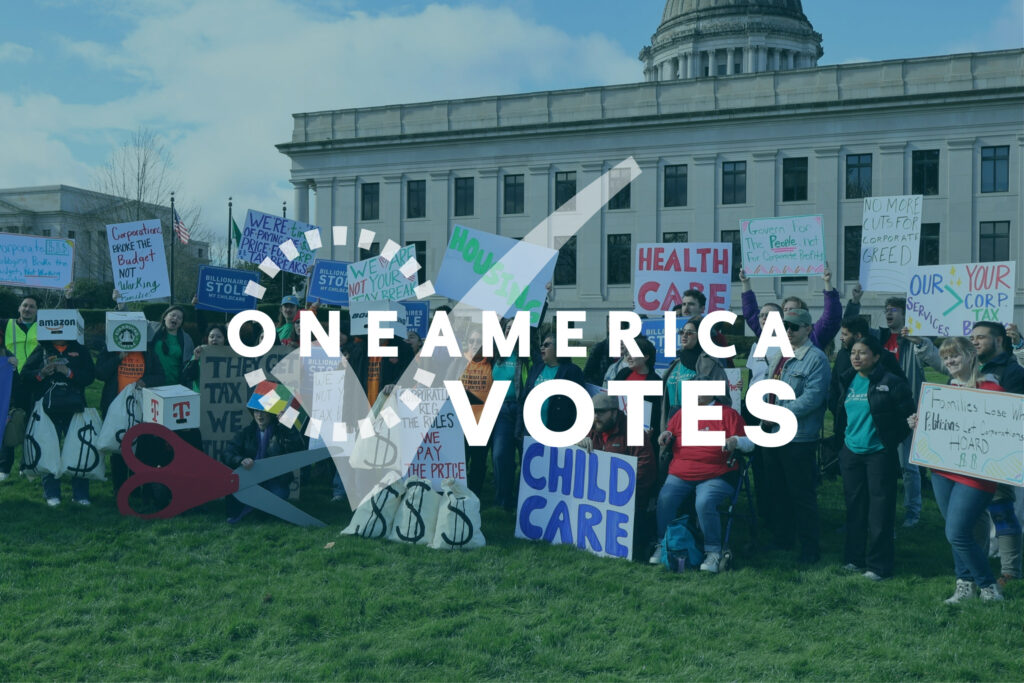
OneAmerica is relaunching our regular newsletter updates!
If you were reading our newsletters last year, know that we’re still going to be sending out information about federal news and highlighting work here in Washington. We’re also going to be sharing actions you can take in your community and events from OneAmerica and our partners, where you can get more involved.
However, we are making a few changes.
This newsletter will be coming out once a month, at the beginning of the month. We’ll also be publishing them online, on OneAmerica Votes’ website. If you want to make sure that you receive these in your email inbox, sign up for our newsletter.
We’re also hosting monthly immigration updates on the first Wednesday of the month. We had our first one earlier this week. These will have much of the same content as the newsletter, but with some more analysis as well as time for questions.
Our next immigration update presentation will be May 6 at 5:00pm. Mark your calendars today.
Now, on to the news:
DHS Funding
As of the morning of April 3, 2026, our government remains partially shut down. Negotiations are ongoing, and Congress is on recess until mid-April.
This shutdown, which started on February 14th, only affects the Department of Homeland Security.
In response to public outcry of mounting violence and murder of immigrants and U.S. citizens, Democrats are refusing to give money to ICE and Customs and Border Protection (CBP), which are both housed in DHS, without key agreements in place. These include no more masks for immigration agents, requiring agents to honor judicial warrants, and mandating body cameras.
The shutdown means about 57,000 TSA agents were not paid for over 40 days. This resulted in chaos at airports and forced to rely on savings and food banks. Democrats tried fund TSA, but Republicans rejected deals to pay TSA agents eight times.
Earlier this week, Republicans announced a plan to fund the rest of DHS, including TSA, FEMA, and the Coast Guard.
In response to the long lines, the president sent ICE agents to airports across the country. They have been confirmed in 14 airports, sowing fear and less order. (Seattle is not one of them.)
As one CNN reporter at the airport in Houston noted, “they’ve been kind of standing around the edges, clearly not involved in helping process the thousands of passengers trying to make their way through.”
Nonetheless, the White House Border Czar has already said that ICE agents will likely remain deployed to airports even after TSA agents are being paid again.
Proposed Policy Changes
While the ICE agents are the big, splashy news, the federal government is finding quieter ways to make daily life harder for immigrants and their families.
There are two pending changes we want to highlight:
Asylum Employment Authorization Documents
A proposed new rule would make it much harder for asylum seekers to apply for work permits and make some permit renewals more difficult.
Seeking asylum is a right everyone has under both US and international law. You must seek protection when you arrive at a US port of entry, a border, or within the country. This is different than being a refugee, where the claim for protection is weighed before arriving in the US. And as part of living in the US, asylum seekers can apply for work permits, known as employment authorization documents (EADs).
Asylum-seekers often must wait months, if not years, for their cases to be heard. During this time, they must be able to legally work to support themselves and their children with food, housing, and other basic needs.
This proposed rule would pause the processing of all EADs when the total processing time for EADs exceeds 180 days. According to USCIS, it would take between approximately 14 and 173 years to get the processing time under 180 days.
This rule does not ban asylum-seekers from applying for EADs outright, but it does make it practically impossible for asylum seekers to work. This rule provides no benefit to anyone—it simply hurts people already seeking safety within our borders.
Multi-status federally subsidized housing
Another proposed new rule would make it impossible for multi-status families to get and maintain federal housing assistance.
Currently, citizens and immigrants with status can apply for federal housing assistance, while declining to share the citizenship status of everyone in their home. Mixed status families – where some members of a family may be citizens or legal residents, but others are not – can stay together. The federal government only pays for the people who have legal status.
This proposal would prohibit families with mixed immigration status from receiving housing assistance or living in either public or Section 8 housing.
If adopted, many families would have to choose between going homeless or breaking up. 80,000 people could be evicted from their homes. That includes approximately 37,000 children, nearly all of whom are themselves U.S. citizens.
Administrative changes like these make it harder to survive as an immigrant in this country. That’s the point: to increase fear, keep people isolated, and make it harder to survive.
But there is one way you can fight back: you can submit public comments.
When federal agencies change policies, they must allow the public to comment on how this will affect them. Typically, this means the public gets 30 to 60 days to submit comments.
Comments are public record. Even if the agency enacts the rule anyway, an ensuing lawsuit can use the comments as proof that the agency did not take public will into account.
Anyone can submit a comment, regardless of citizenship. All you need is an email address.
The process is simple. We walk you through how to comment on our website – and we even have comment generators built in to help you draft what you want to say.
Washington State Legislative Session
This was a short legislative session, but we won a lot in Washington this year.
We strengthened our democracy, won protections for workers, and gave our state officials more tools to enforce civil rights and worker rights. We also took a major step toward rewriting our tax code, coming closer to a reality where the wealthiest people in our state pay what they owe our communities.
We’ve got a full legislative wrap up on our website, which we highly encourage you to read, but here are some of the highlights:
The Immigrant Workers Protection Act (HB 2105) puts more responsibility on employers to keep immigrant employees safe. Now, when an employer receives notice from the federal government that there will be an I-9 audit, checking employment verification, employers must give their employees notice in advance. This law also requires businesses post information about workers’ rights, and it protects workers who use those rights from retaliation.
This bill puts power back in the hands of workers at a time when immigrants are under attack by the federal government.
On the voting rights front, this year, we passed two bills signed into law that strengthen the Washington Voting Rights Act (WVRA), which OneAmerica helped organize to pass in 2018.
The first bill is Preclearance (HB 1710). Preclearance requires places with a history of discriminatory voting practices to get approval for changes in election policies or electoral maps before enacting them.
Federally, preclearance was part of the Voting Rights Act of 1965. As a result, voting rates among voters of color increased, as did the diversity in elected officials. However, in 2013, the Supreme Court gutted preclearance in the case of Shelby County v. Holder. Congress hasn’t passed a new version yet.
Now though, preclearance is the law here in Washington for our state and local elections. This will prevent discrimination before it happens.
Together with another voting rights bill, Guidance on Voter Suppression/Vote Dilution (HB 1750), our state has shifted the burden of protecting our right to vote from individuals to the local governments who might enact policies that suppress voters’ rights.
At a time when our civil rights and our democracy are under attack by our own federal government, Washington has stood up for our vision of a democracy where every voice matters.
Finally, we can’t wrap up this section without mentioning the Millionaires’ Tax, the first step to addressing Washington’s regressive tax system.
This bill applies a 9.9% tax on any money earned over $1 million, starting in 2029. This means that if you earn $1,000,010, you’ll only be taxed on $10 and pay $0.99.
The money from this tax will go toward expanding the Working Families Tax Credit and supporting childcare and early learning. It also eliminates sales taxes on products including diapers and toothpaste.
None of these victories happened overnight. OneAmerica has been fighting to strengthen voting rights in Washington since 2012, and fighting to win preclearance for over a decade. The fight to reform Washington’s upside-down tax code has been going on even longer. Thousands of people and dozens of organizations were involved in these fights, contacting their legislators, showing up in Olympia, and electing champions to work alongside us.
There is a lot more we could talk about. Mask bans for law enforcement. New tools for the Attorney General’s office to protect immigrants under Keep Washington Working. The Driver Privacy Act. Check out our session wrap up on our website for a deeper dive.
Other News
The news moves fast, and there is only so much we can cover in an email or blog post. Below are some other stories that caught our eye over the last month.
ICE Arrests in Washington
“In Washington alone, ICE officials made more than 2,340 arrests last year, up 152% from 2024 figures.” (Seattle Times)
A report from the UW Center for Human Rights detailed the impact of ICE arrests in Washington State. Yakima County has been hit hardest, with 185 arrests per 100,000 people.
Markwayne Mullin
“I think some things administrative will change… but I am unclear of noncosmetic substantive improvements” (New York Times)
Kristi Noem is out as head of the Department of Homeland Security. Her replacement, Markwayne Mullin, is a senator from Oklahoma whose goals are still the same: to run a mass deportation campaign.
Pam Bondi
“DOJ’s independence, integrity, and workforce have degraded more under [Bondi’s] leadership than at any other time during the department’s 155-year history.” (The Hill)
Pam Bondi was fired by President Trump on April 2, 2026 after approximately 14 months. This was the shortest tenure for a Senate-confirmed Attorney General in 60 years.
Dilley Detention Center Part 1
“One parent told us that their 5-year-old asked, ‘Are we bad people? Are they going to kill us here?’” (NBC News)
The US is only legally allowed to hold children in detention facilities for 20 days. However, in January, at least 900 children had been confined for at least that long at the Dilley Detention Center in Texas.
Things got so bad that the children inside the detention center started a letter writing campaign. In response, guards confiscated their crayons and drawing paper.
Dilley Detention Center Part 2
“I’ve worked with kids across so many communities, and they have beautiful differences, but they are also so similar. They want to play, they want to learn, they care about each other.” (Mother Jones)
The good news? As of mid-March, ProPublica reported that only 54 people were still being held at Dilley.
One of the people who has been fighting hard to release these children is Ms. Rachel, an online children’s educator. She used her platform to highlight the cruelty of ICE detention of children, sharing a now-viral video of her FaceTiming with a 9-year old boy held at Dilley who just wanted to go home to attend his spelling bee.
He’s home now.
Plyler v. Doe
“Our kids in Tennessee are not your legal experiment” (Nashville Banner)
In 1982, the US Supreme Court ruled in Plyler v. Doe that all students have a right to free K-12 public education, regardless of their citizenship status.
This year, the Tennessee legislature is working to pass a bill which would require schools track and report undocumented students – and set up a legal challenge to Plyler. It’s unclear if the bill will pass in the remaining weeks of the legislative session.
DACA
“You feel like a dog on the corner waiting for somebody to feed them” (Chicago Tribune)
DACA is the program started under President Obama which give undocumented people brought to the US by their parents the ability to legally work in the US. Every two years, they have to renew their status. Without this renewal, they can’t work.
Now, under the Trump 2.0 administration, renewals are taking a lot longer – and people are losing their jobs through no fault of their own.
Take Action
Comment on Federal Rule Changes. Submit a public comment today before the deadlines to comment on changes to work permits for asylum-seekers (April 24) and mixed status housing (April 21).
Pledge No Work, No School, and No Shopping on May Day. May 1st is International Workers Day, and this year, it’s also a day of national mobilization against authoritarianism. Join us and pledge to not working, shopping, or going to school on May 1st.
Organize Your Neighborhood for May Day. It’s going to take all of us to fight back against the attacks on our democracy. Join us next Wednesday, April 8, for a virtual training on how to organize your neighbors to take action on May Day. RSVP today.
Sign Up for our May Immigrant Right Update Webinar. Our next virtual update is going to be at 5pm on May 6. Register today.
That’s all for this month!